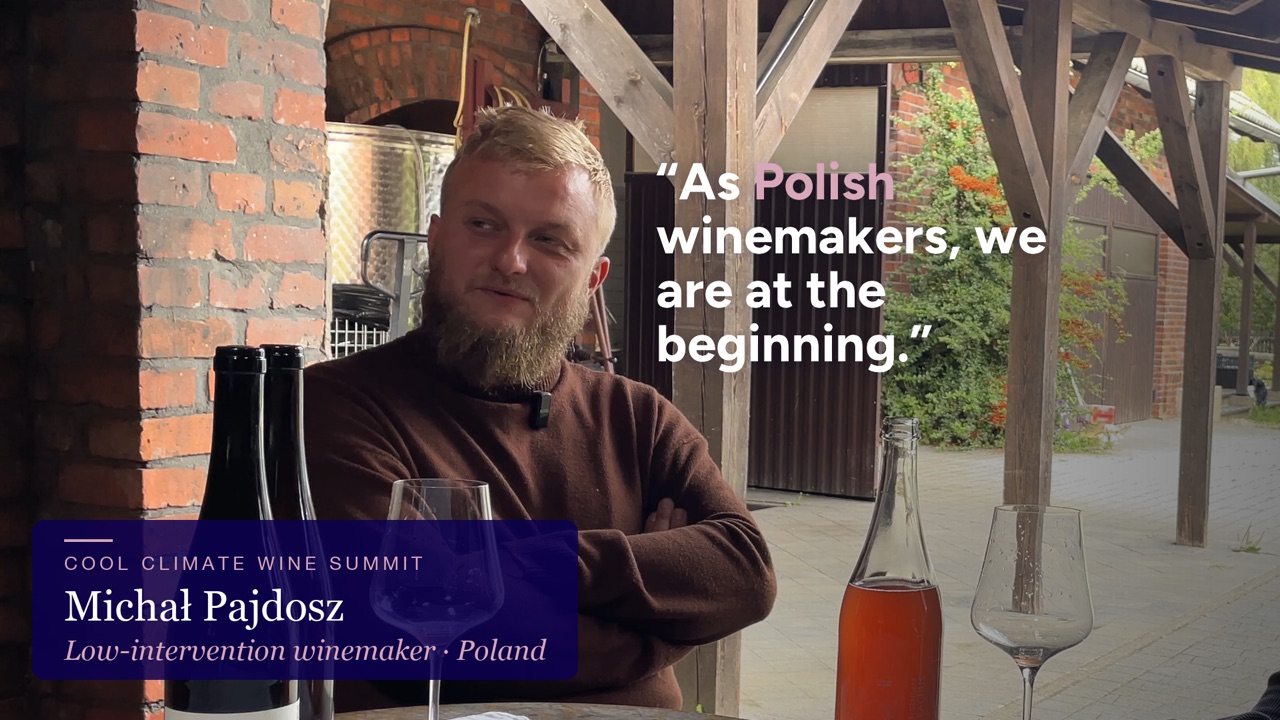
Winnica Jakubów sits on the Dałkowskie Hills in the south-west of Poland, half an hour from Zielona Góra, on ground the glacier left above a river valley. You can see the horizon in both directions and the wind never stops, which is the point.
Michał Pajdosz's father planted the first vines here in 2002: a small parcel with a lot of varieties, to find out what would survive a winter, what would set fruit and what would make wine. Tiny fermentations, tiny bottlings. It was one of the first Polish wineries attempting anything like scale, in a period when growers swapped planting material with each other because there was nowhere else to get it.
The most cheerful view is when my neighbours are drinking my wine through the fence.
Michał Pajdosz, Winnica JakubówThe Biotechnologist Who Makes Bows
Pajdosz studied biotechnology in Wrocław and started making wine at twenty-three. Asked what he would do otherwise, he does not reach for another white-collar answer. He has been a beekeeper. He has been a bowyer, making self-bows from wood for historical re-enactment. Carpentry, leather, horn: he has spent his life making things with his hands, and the alternative he describes is sitting in an office in Wrocław suffering from not being in the countryside.
The influence he names is not a person but a shock. Early in his career he spent time with organic Champagne producers, Marc Augustin and De Sousa among them, expecting to find a technological process. What he found was parcels tilled by horses and an ecosystem, a quality and a method that were all the same decision. He came home understanding it as an artistic process, and noticing that producers in their tenth generation were still experimenting.
Asked to describe himself as a bottle he goes rustic and slightly awkward: something not everyone will like, with good roots and a softened structure. A vin jaune from the Jura, he decides, or a Slovenian orange.
Rondo, and Three Years of Waiting
The first wine is a pét-nat rosé of Rondo and Regent, spontaneously fermented, the 2022, three years on the lees. The idea came back from England, where the serious estates have moved to Chardonnay and Pinot Noir and the traditional method, and the hybrid plantings of earlier decades get turned into pét-nat instead.
Rondo and Regent are not varieties anyone is enthusiastic about any more, and both colour so heavily that only a small fraction of the juice can go into a rosé. Pajdosz's honesty about the trajectory is the useful part: at the start it was boring, strawberry and cream. The fruit has since dropped, the acidity has come up, and the wine has turned chalky and faintly funky. He likes the last bottles considerably more than the first.
It is through malolactic and has seen no oak, and it has arrived somewhere unexpected for a pét-nat: soft, integrated, creamy, with real body. It reminded me of the Blaufränkisch rosé Michaela Riedmüller makes in Carnuntum, which is the most complex rosé I have tasted. This is a bottle you would put with shellfish rather than with the garden.
It also marks how fast the problem has reversed. His father fought chronic unripeness and punishing acidity, and planted Rondo and Regent because little else survived the winter or ripened at all. Pajdosz now has to be careful not to pick too late, with too much alcohol and not enough acid. Pinot Noir and Zweigelt are going in.
Amphora, Traminer, Christmas
The second wine is an amphora orange from 2023, made for one of his distributors and in bottle for three weeks when we tasted it. Gewürztraminer with Hibernal, because Traminer on its own loses acidity too readily and came out soft after malolactic. More than half a year on the skins, under ten per cent stems, then further ageing on the lees in the amphora.
The nose is a deep, tea-like florality rather than the perfume you would brace for from Traminer. There is a savoury minerality, and on the palate a pronounced orange zest that put me in mind of Christmas; Pajdosz points out that the Polish Christmas drink is made from dried fruit, so the association is not accidental. He says the site gives herbal wines across the whites and the oranges, which is why Traminer can be used here without the aromatics running away.
The tannins, after six months of skin contact, are gentle. He thinks that is the material rather than the method: these varieties at this latitude gave everything they had, and no amount of heat or extra maceration would produce a heavy Georgian style. Johanniter, by contrast, can go harsh and tannic on anybody.
Time, and Blending Across Vintages
Nothing here is filtered. Tartrate and protein stabilisation happen through patience, lees and some oak, and he notes that a barrel can polish a wine clear on its own. A Riesling that stalls short of dry is not corrected; it waits on lees until the next harvest brings yeast strong enough to finish last year's sugar.
More unusually, he blends across vintages deliberately, particularly in the reds, taking freshness from a younger year and seriousness from an older one. The reasoning is that the vintage swing here is wide enough that consistency is otherwise impossible, and that a wine you know will be blended can be designed for the job. He does the same with the oranges: several macerations at different temperatures and skin contacts, some Hibernal with Traminer, some Traminer alone, assembled afterwards.
The experiments keep coming. A first still Chardonnay last year in old 350-litre French barrels, high in acidity, from fruit that normally goes to sparkling. A blanc de noirs base from Pinot Noir this year. Oxidative ageing, Jura-style, is on the list.
The Man Other Growers Name
I did not come to this subject by myself. Esben Madsen at Winnica Silesian named Pajdosz when I asked who had shown him the ropes. So did Wiktoria Rypson at Saint Vincent. He also runs study trips, with Polish growers travelling together to Moravia, Champagne, Germany and France.
His own account is less heroic and more interesting. He was always more drawn to the craft than the selling, so when other projects asked him in he said yes, and in some years he has been involved in more than sixty fermentations. That is a lot of chances to learn, and a lot of chances to make mistakes quickly, which he considers the job: Polish winemaking is at the start of a long road and somebody has to make the errors that clear it.
The estate carries more than ten labels of its own, plus small batches made directly for distributors, which lets him release an idea without inventing another brand for it. One of them is a one-litre bottle, a rural wine meant for the tables around here. He is sceptical of the new Polish vineyards that price themselves as premium from the first vintage, on the grounds that a wine country is not built from the top down.
In five years he wants to be in the same place, better organised on the selling side, with the guest rooms reopened and some small agritourism running. After a decade mostly on the road with wine, at tastings and festivals, he wants to settle here and do the hard work instead.
By hard work he means soil: piles of wood chips and horse manure to move, and the slow business of learning to be properly organic rather than nominally so. He is pointed about the difference. A vineyard can be certified and still be degrading its site with too much copper or with nano silver. What he wants is to restart the engine that is asleep down there.
Winnica Jakubów pours at the Cool Climate Wine Summit in Copenhagen. Ask for the orange, and ask him what is in it, because the answer changes most years.