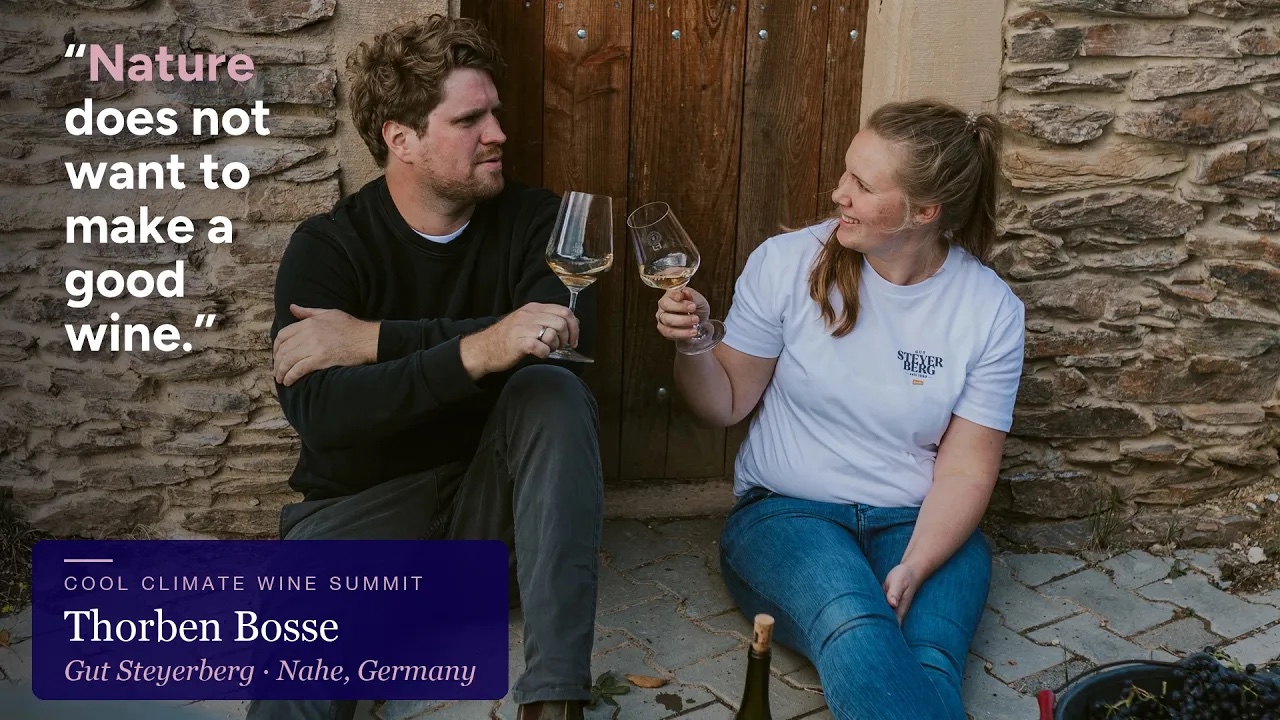
Thorben Bosse studied pharmacy before he studied wine, and he says he was the worst chemistry student of his year. In winemaking he was one of the best. The subject was the same; what changed was what it was for.
That is not a throwaway line about a career change. It is the whole argument of the estate. Gut Steyerberg works with no additions it can avoid, no sulphur in the red, no filtration and no stabilisation, and Bosse's point is that this demands more chemistry rather than less. You have to know what is happening in the ferment to be able to react to it. Anyone can make one good natural wine by luck. Nobody makes ten vintages of them that way.
If you are getting closer to nature, it is not easier. Nature does not want to make a good wine. Nature wants to make what is easiest.
Thorben Bosse, Gut SteyerbergThe winemaker's job, in his description, is not to overrule that but to shape the conditions nature then works in. Which is also how he talks about nature itself: not as a partner that flatters you, more like family. A stable thing to have, and somebody permanently kicking you in the back when you have not done your work.
One Hill, and the Name on the Label
Gut Steyerberg is a young name over an old estate. Bosse took over one of the first Demeter wineries in Germany, at Schweppenhausen in the Nahe, and founded his own in 2023. He is not from the family that built it, so he did not want the family name on the label, and he did not want his own either.
What went on the label was the place. Sixteen hectares of vines, all of them on one hill, plus more than forty hectares of grassland, woodland and orchards around them. No grape leaves the hill before it is in the bottle and labelled. For a German estate of that size, holding a single contiguous vineyard is unusual enough to be the point of the name.
Asked who shaped his style, he names Martin Darting in the Pfalz, who runs the PAR tasting system and is involved in the International Organic Wine Award. They meet four or five times a year to taste and argue about the ferments. What Bosse values is not approval but explanation: somebody who can say why a flavour is there, why it shows in a Riesling and not in a Pinot Blanc.
Asked which bottle he is, he answers sceptical purist. Straightforward, but thinking too much. The wine he picks for himself is the estate's own Purist, from 2023.
The Purist, and a Grape That Ripens Too Fast
The Purist is a cuvée of orange Gewürztraminer, Cabernet Blanc and a little Riesling, bottled in December 2024 after more than a year on the lees. It is meant to be the easy one, the starter, without being simple. The Gewürztraminer gets two weeks of skin fermentation in 400 litre oak, four barrels a year and never more, because the fruit has to be clean enough to go onto its skins at all, and in most vintages that takes a great deal of sorting.
The Cabernet Blanc is the interesting problem. It ripens too fast, losing acidity before the rest of it is ready, and Bosse will not acidify. So he ferments it on the skins for six or seven days, until about half the sugar has gone, presses it gently, moves it to steel and tops it up with a layer of berries to keep the oxygen off. What comes out is low in acidity and high in tannin, which is the trade he is after: structure instead of acid, with the black pepper and bell pepper the site gives him, and the flowers of the Gewürztraminer over the top.
On its own, he says, the variety is too much to drink a bottle of. It is very green, very intense, very peppery, and it goes extremely well with spicy food. In the blend it supplies the substance.
Tannin Instead of Acidity
This is where the cellar work meets the climate question, and Bosse's answer is more practical than most. Riesling at this site is still high in acidity, so for now nothing needs rescuing there. The varieties that already struggle to hold acid are a different matter, and his conclusion is that the industry will have to stop relying on acidity to keep wine fresh and stable.
If you have well-structured tannins, they work as freshness. If they are not covered up in creamy oak, if they are precise and fresh, you get freshness in the wine without acidity.
Thorben BosseHe points out how recent the change is. Ten years ago nearly every Riesling was whole-bunch pressed with ten minutes of skin contact and then kept as clear as possible. The rise of skin-contact wine since then is not a fashion, in his reading, so much as an early answer to a problem that is going to get worse.
What Demeter Actually Looks Like
The second half of the interview was recorded not at the stirring barrels, which is where the pictures are usually taken, but in the store where the preparations are kept: horn manure, horn silica, the compost preparations.
His explanation of what they are for is blunt. After fifty or a hundred years of conventional farming most of the life in a soil is gone, and it does not come back on its own. The compost and the preparations are the way of putting the information back, so the soil knows how to behave again and the vine knows how to grow. No fertiliser, no chemical treatment. Every organic grower wants a living soil, he says. Demeter found a way of getting there faster, and it still takes generations.
He is open about not arriving through the theory. He arrived through tasting. At university he found he could pick the biodynamic wine out of a flight of twenty: not always the best one, not always the easiest to drink, but always a little more intense, a little more structured, a little more individual. That was enough to make him try it, and he has now been doing it for about ten years.
Nought Point Two Per Cent to Over Two
The number he offers for all of this is a humus figure. Vineyards here that started at 0.2 per cent humus are now above 2 per cent, and have held it for over twenty years. That is the practical case for the method: humus is food for everything living in the soil, and a soil with enough of it carries water through a drought and absorbs a heavy rain.
The estate could irrigate. Every vineyard is within five hundred metres, the pipes would be straightforward, and it does not. Bosse is careful not to claim he is unworried about the climate, which would be too strong. His claim is narrower: that a living soil is resilient against it, and that you can get a vineyard to that point if you are prepared for the first ten years to be annoying.
He has a comparison for a vineyard being converted. You take something that has been living on fast food and hand it a vegetable garden. It is not grateful. Growing your own food is hard work.
Wine Pays for the Landscape
The forty hectares around the vines are not decoration. Trees, extensive grassland, orchards, all of it planted to keep the vineyard alive, and all of it paid for by the bottles. We make wine to have the money to do landscaping, he says, and then adds that the vineyards still have to pay for the rest, so it cannot be done purely for pleasure. He has planted a great many apple trees and reports getting almost no apples, which he cannot explain either.
Slate Pinot, No Sulphur
The red in the glass was the 2022 Pinot Noir, released days before the interview. A seventeen-year-old vineyard, one hundred per cent whole bunch, spontaneous fermentation for three weeks with pump-overs twice a day, and no sulphur at any stage. The analysis shows around eleven milligrams per litre, all of it the wine's own.
It is 12 per cent alcohol from a hot, dry vintage, with acidity around six grams. The young plantings paid for that vintage: in every vineyard under seven years old the fruit was dropped on the ground, because it was not possible.
What is in the bottle is a slate Pinot, which is the opposite end of the category from the limestone and chalk sites that define it elsewhere: dusty rather than fruity, firmly tannic from the whole bunches, with cherry fruit that has not been cooked. The vineyard is a selection massale of nine Burgundy clones, so the next decade of it will not taste like one wine.
Because the wines are made this way, they open slowly. The bottle tasted here had been open two days and was better for it, which is his standing recommendation rather than an apology.
Five years from now, he says, Gut Steyerberg will be in the same place, which is rather the point of naming an estate after a hill. More wines that could only come from this site, more Pinot, Chardonnay, Riesling, Pinot Blanc and the orange Gewürztraminer, and a good deal more of it sold in Denmark.
Gut Steyerberg pours at the Cool Climate Wine Summit in Copenhagen in January, in the Demeter corner with the other biodynamic growers.